Top 07 Fast Growing Trees That You Can Grow For Privacy

The trend of growing “Fast-growing trees” is becoming the latest craze in the world of landscaping. We are getting excited about it, and we want it right now. The beauty of the landscaping is overwhelming, and it is attracting the interest of homeowners, especially those who enjoy the serenity and elegance that comes with growing a garden of Fast-growing trees.
Considering the popularity of TV shows staged for “do-it-yourselfers” that are showing instant results in the remodeling of homes and landscaping, modern homeowners have come to expect the same immediate gratification in their own landscapes, too.
The desire for Fast-growing trees in your landscape is not just for fun anymore. Fast growing trees are beneficial in a lot more ways. An important factor is the ability of the trees to provide energy savings in the form of shade. A big tree that is properly located will shade the house from the scorching summer sun and lower the demand for air conditioning.
In the case of a deciduous tree (which it is expected to be), it will shed its leaves in the fall, and it will now allow the winter sun to penetrate through the open branches and warm the home, thereby lowering the demand for heat.
Prevention of soil erosion is another great benefit of planting Fast growing trees. They provide homes for birds, squirrels, butterflies, and other little critters that want to stay away from predators and also prefer the safety of being off the ground. Some trees do have flowers that provide pollen for the bees.
They give beautiful sights and interest in the landscape. You can install a hammock for lounging on a summer afternoon and hang a swing to play and catch some fun too. You can erect a treehouse. You can climb a big tree. The possibilities are only restricted to the level of your imagination.
One other factor of Fast-growing trees is their ability to absorb carbon dioxide from the atmosphere. Carbon dioxide is understood to be a major contributing factor to global warming, and expelling it from the air will lower the rate at which global warming occurs.
Landscaping with fast-growing tree species gives you some level of privacy from the outside world. Even if you build a six-foot wall around your home, neighbors may still see what is going on in your yard. Other factors make planting fast-growing trees desirable; for instance, the rays of shining lights that reflect into your home at night from an outside lamp post that you may find uncomfortable. In any case, it is also important to know the type of trees to plant that suit your privacy screen.

Why Fast Growth Matters
Rapidly maturing privacy trees deliver benefits that go beyond mere aesthetics. When a tree adds 3 to 8 feet of new growth each year, it:
-
Provides quick visual seclusion, shielding patios and windows from prying eyes.
-
Blocks unwanted noise by forming a dense foliage wall in just a few seasons.
-
Stabilizes soil quickly, reducing erosion on slopes or embankments.
-
Creates habitat for birds and pollinators sooner, enriching your local ecosystem.
In regions with strict landscaping timelines—whether due to homeowners’ association rules or personal impatience—trees that shoot up rapidly can be a game-changer. They turn empty borders into verdant retreats almost overnight, making fast growers the first choice for savvy gardeners.
Selecting the Right Fast-Growing Privacy Trees
Before digging your first planting hole, consider these key criteria to ensure success:
-
USDA Hardiness Zone: Match tree species to your climate to minimize frost damage and guarantee vigorous growth.
-
Mature Size and Spread: Account for both height and width to avoid overcrowding or root conflicts with underground utilities.
-
Sunlight Requirements: Most fast growers thrive in full sun, but partial shade tolerance can expand your planting options under tree canopies or along shaded fences.
-
Maintenance Needs: Faster isn’t always easier—some species demand regular pruning to maintain shape, while others are virtually maintenance-free once established.
-
Root Behavior: Select non-invasive root systems for close plantings; species like hybrid poplar can send out suckers if not properly managed.
Balancing these factors will guide you to the perfect match for your yard’s conditions and design vision.
Read More: Everything You Should Know About Tree Service
Getting These Fast Growing Tree Species
Now, you can get a good mature tree uprooted and transplanted directly into your yard straight away, but that can be very costly. Rather, you can do a quick search and locate places where you can buy the seeds so you can do the planting all by yourself.
An easy way out is to browse online using search engines. There are a lot of useful websites out there where you can get the needed evergreens from. Also, you can browse the local business directory. Oftentimes, there are stores near you that will sell young saplings to you at an affordable cost.
Read More: Why Trees Are Great For Your Garden And How To Choose Them
What are the available Fastest Growing Tree Species Options?
There are loads of different fast-growing tree types to choose from. Below, we shall be looking at some of them that today’s homeowners desire and grow:
1. Green Huge Arborvitae (Thuja standishii x plicata)
This is a long-lasting, hardy, evergree,n fast-growing tree that grows 3-5 feet every year. They are cedar plant that looks like Junipers but are only lighter in texture and color.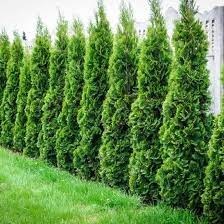
These plants grow round and densely. They can grow as high as fifty feet. If you desire a hard, tall screen, this plant will meet your demand.
Arborvitae like full sun and well-drained soil.
Similarly, another option to the Green Giant is the Leyland Cypress tree.
2. Tulip Poplar (Populus nigra ‘Italica’)
Unlike the Arborvitae, another fast growing tree is the Poplar tree. Most homeowners prefer the poplar look when comparing the two trees. The poplar trees are extremely fast-growing trees. They grow up to six feet every year.
Why then, don’t people always plant Poplar trees for a privacy screen? The simple answer is that Poplars are often exposed to the disease. They are prone to getting cankers.
In addition, they have a short life span. They can only live for around twenty years. Those who live to maturity usually do not look very good at the tail end of their lives. Poplars also thrive on well-drained soil and full sunlight.
3. Bamboo Tree
The bamboo tree is the world’s fastest-growing tree. It can grow up to 3-4 feet in just one day. Some Bamboo may grow as tall as 75 feet high.
There are over a hundred varieties, so choosing the right Bamboo tree seems tasking. The simple way to decide on it is to buy the kind that you have in your nursery at a given time.
Clumping Bamboo is easier to contain and grows slowly. Taller and more aggressive, Bamboo can be said to be the running type. Running Bamboo can be contained by burying a plastic mechanical barrier.
The Yellow Grove Bamboo is a type of Bamboo that many people love.
4. Hybrid Poplar
There are many crosses called “hybrid poplar”, but this one, between the eastern cottonwood of the United States and the black poplar of Europe and North Afric,a has long been a favorite.
Botanists and amateurs are said to have exchanged mother trees across the ocean in colonial times, so natural and artificial hybrids soon emerged. The oldest report on the tree was given by a scientist in 1785.
A very private tree is fast growing, up to 5 to 8 feet a year. It has silver-green leaves and a wide shade in the shape of a tree. They are usually planted for very fast shade or can be harvested for firewood in 5 to 7 years. It’s a cotton-free hybrid. Replant from the catwalks. Grows at 40 feet at 50 feet, 30 feet of dispersion (zones 3-9)
5. Weeping Willow
The weeping willow tree is dramatic both in appearance and history. Few trees add so much grace to the landscape. At the beginning of the history of international trade, cuttings of this popular species were transported from China along trade routes.
His appearance along the Euphrates eventually led the famous botanist Linnaeus to believe that it was the grass of the biblical mention, so he gave it the scientific name Babylonia. Later, it was the shadow of a weeping willow that comforted Napoleon during his exile on the island of St. Helena.
After Napoleon was buried under his favorite tree, the cuttings from him became an estimated price among his fans all over the world.
Elegant and refined, it is easily recognizable by its open crown of curved branches on the ground. The leaves are light green above, and underneath they are greyish green. This willow grows especially well close to the water and reaches 30 feet to 40 feet tall, 35 feet in extension. (zones 6-8)
6. October Glory Red Maple

A very fast-growing variety of red maple. This always-popular maple should look like a beautiful shade tree for any farm.
Bright dark green leaves in spring, and summer turn bright red in late autumn and last several weeks. Tiny and eye-catching red flowers bloom in spring. The striking red fruits attract many birds and other wild animals.
It grows 40′-50′ tall with an extension of 25′-35′. Tolerant of many soils, but prefers slightly acidic and humid conditions. Plant in partial shade until full sun.
7. River Birch “Betula nigra“
River birch wood was once used for ox yokes, clogs, and other farm products. But they were discolored by woodcutters rather than knotty and rough, so they often had to grow along the riverbank to control erosion.
As the name suggests, the birch of the river grows naturally along the riverbank. But as a landscape tree, it can be planted almost anywhere in the United States.
The species is appreciated for its relatively rapid growth, moisture tolerance, and certain dryness, exclusive curling ropes, elastic limbs, and relative resistance to birch drills.
The birch of the river has not yet reached the popularity of many maples and oaks, but it is on its way. In 2002, one of its varieties was even called Urban Tree of the Year by the Society of Municipal Arborists.
Top Fast-Growing Privacy Trees at a Glance
| Species | Growth Rate (ft/yr) | Mature Height | USDA Zone | Sunlight |
|---|---|---|---|---|
| Hybrid Poplar | 5–8 | 40–50 ft | 3–8 | Full sun/partial shade |
| Green Giant Arborvitae | 3–5 | 40–60 ft | 5–8 | Full sun/partial shade |
| Leyland Cypress | 3–5 | 60–70 ft | 6–10 | Full sun |
| Dawn Redwood | 2–3 | 50–70 ft | 4–8 | Full sun |
Hybrid poplars stand out for their lightning-fast growth—up to 8 feet per year—thanks to a vigorous genetic cross between native poplar species. In just five growing seasons, you can enjoy a 40-foot tall hedge that rustles with light breezes and casts dappled shade. Their oval canopy and slender trunks make them ideal for narrow borders, but you’ll need to plan for a 30–35 foot spread at maturity to prevent overcrowding. Tolerant of a wide range of soils and very disease-resistant, hybrid poplars flourish in USDA zones 3 through 8, shining in both urban and rural settings.
Green Giant Arborvitae: Evergreen Elegance
If year-round privacy tops your list, look no further than Thuja ‘Green Giant’. This coniferous powerhouse gains 3 to 5 feet annually, reaching heights of 40 to 60 feet with a graceful, pyramidal form. Adaptable to various soil types, it thrives in full sun or partial shade and stands up to wind and cold in zones 5 through 8. Its dense foliage requires minimal clipping, making it a low-maintenance screen that retains vibrant green color from winter through summer.
Leyland Cypress: The Classic Columnar Screen
Leyland cypress (Cupressus × leylandii) has long been a landscaper’s secret for creating near-impenetrable barriers. With a mature height of 60 to 70 feet and a 10 to 15 foot spread, these evergreens form a tight, columnar wall of feathery foliage. In favorable conditions, they can shoot up 3 to 5 feet per season, offering a swift privacy solution in USDA zones 6 through 10. Although they demand regular pruning to maintain their shape and prevent wind damage, their rapid growth rate and dense canopy reward the effort with an almost instant living fence.
Dawn Redwood: Deciduous Drama
Metasequoia glyptostroboides, or dawn redwood, combines fast growth with a sculptural silhouette. Adding roughly 2 to 3 feet each year, it reaches 50 to 70 feet in maturity and unveils fiery bronze foliage each autumn before shedding its needles. Suited to zones 4 through 8, dawn redwoods thrive in moist, well-drained soils and full sun. While they lose leaves in winter, their wide, layered branches still form an effective screen in the growing season and deliver a breathtaking seasonal show.
Designing an Effective Green Screen
Crafting a privacy hedge goes beyond planting a single row of trees. Consider these design strategies:
-
Staggered Rows: Offset trees in two parallel lines to eliminate sight gaps and enhance density.
-
Mixed Species Planting: Pair evergreen and deciduous fast growers—for instance, hybrid poplar with Green Giants—to balance year-round screening with seasonal interest.
-
Understory Fillers: Add shade-tolerant shrubs like viburnum or holly beneath taller trees for extra screening at eye level.
-
Layered Heights: Use shorter, quick-growing shrubs in front of taller trees to create depth and multiple privacy tiers.
Conclusion
Conclusively, there are many faster-growing trees that one can grow as one desires. The few highlighted above are only examples of what you could choose from. Whatever you desire for your yard, it is easy to find the one that fits in and works with your project. You can easily get them at a cheap cost, and they grow quickly. Fast-growing trees will add life, sophistication, color, and beauty to your yard all year long.