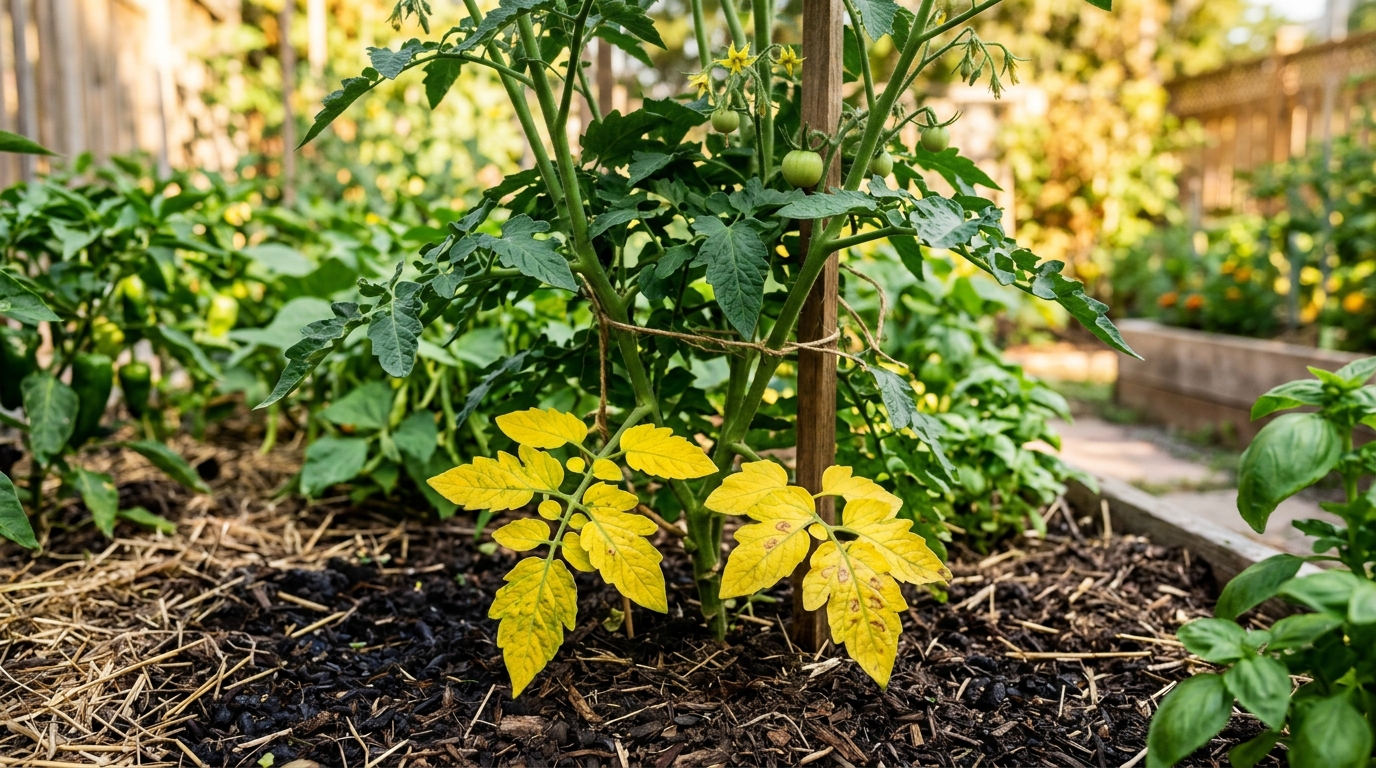
Tomato leaves turn yellow for a handful of reasons, and where the yellowing starts tells you which one. Yellowing that begins on the lowest leaves with brown spots usually means a fungal leaf disease such as early blight or Septoria leaf spot. Even, pale yellowing of the older leaves without spots points to nitrogen shortage, which is common in containers. Yellowing on one side of the plant, with wilting, suggests Fusarium wilt. A few old bottom leaves yellowing late in the season, while the rest of the plant is healthy, is normal.
Use the diagnosis table to match what you see, then follow the fixes below. This guide draws on extension guidance from the University of Maryland, University of Wisconsin, University of Minnesota and NC State, listed at the end.
Diagnose Yellow Tomato Leaves
| What you see | Most likely cause | What to do |
|---|---|---|
| Lower leaves with brown spots showing target-like rings and a yellow halo | Early blight | Remove affected leaves, mulch, improve airflow; rotate |
| Lower leaves with many small spots with whitish centers and dark borders, then yellowing | Septoria leaf spot | Same as early blight |
| Older leaves turn evenly pale yellow, then newer ones; no spots | Nitrogen deficiency | Feed with nitrogen, lightly; common in containers |
| Yellowing between the veins | Possible potassium, magnesium, iron or manganese shortage | Soil test before adding anything |
| Yellowing and wilting on one side of the plant or one branch, starting low | Fusarium wilt | Cut the stem to check for brown streaks; remove plant; plant resistant varieties |
| Fine yellow speckling, dirty-looking undersides, hot dry weather | Spider mites | Rinse leaf undersides; horticultural oil or insecticidal soap |
| Tiny dark spots with yellow halos | Bacterial spot or speck | Remove infected leaves; avoid wetting foliage |
| A few oldest leaves yellow late in the season; plant otherwise healthy | Normal aging | Pick them off; no treatment needed |
1. Early Blight and Septoria Leaf Spot
These fungal diseases are the most common reason for yellowing lower leaves in wet summers. The University of Maryland rates early blight as very common. Both start on the lowest foliage and work upward.
- Early blight: round brown spots up to about half an inch across with target-like rings; the tissue around them turns yellow. The University of Minnesota notes it develops between 59 and 86°F and spreads most in wet weather, heavy dew or humidity of 90% or more.
- Septoria leaf spot: many smaller spots with whitish centers and dark borders, followed by yellowing and leaf drop.
What to do:
- Remove spotted leaves as soon as you see them. Minnesota says it is fine to remove up to one-third of the leaves if you catch the disease early.
- Mulch the soil under plants with straw, dried leaves or fabric so rain does not splash spores onto the leaves.
- Space and stake plants for airflow, and water the soil rather than the leaves.
- Rotate: wait two years before planting tomatoes or peppers in the same spot.
- Most home gardeners do not need fungicides. If you use one, Wisconsin notes products containing chlorothalonil or copper must be applied early and repeatedly; they protect new growth but do not reverse damage. Follow the label.
2. Nitrogen Deficiency
Nitrogen moves within the plant, so when it runs short the plant pulls it from old leaves to feed new growth. The oldest leaves turn uniformly pale yellow first, then the yellowing moves up. Wisconsin notes this is especially common in containers, where frequent watering washes nutrients out.
What to do: feed with a nitrogen-containing fertilizer at the label rate, and do not overdo it; too much nitrogen gives large leafy plants with fewer fruit and makes blossom end rot more likely. See our guide to high nitrogen fertilizers for how to calculate a rate.
3. Fusarium Wilt
NC State describes Fusarium wilt as starting with yellowing of the lower leaves that spreads upward, often on just one side of the plant, branch or leaflet. Plants may seem to recover at first, but the wilt becomes permanent, growth is stunted and few fruit develop.
How to check: cut the main stem near the base. Light brown streaks in the inner tissue suggest a vascular wilt.
What to do: there is no cure once a plant is infected, and NC State notes homeowners have no fungicide options. Remove the plant, rotate away from tomatoes for 3 to 5 years, raise soil pH to 6.5 to 7.0 with lime where the soil is acidic, prefer nitrate rather than ammonium nitrogen, and plant resistant varieties next time.
4. Water Problems
Waterlogged soil starves roots of oxygen, and roots that cannot take up water and nutrients show it in the leaves. If yellowing follows a period of heavy rain or constant watering, check drainage. Let the top inch or two of soil dry between waterings in beds, make sure containers drain freely, and avoid the opposite extreme of letting plants wilt between drinks.
5. Spider Mites
In hot, dry weather, spider mites cause fine yellow stippling and leave the undersides of leaves looking dirty. Spray the undersides with a strong stream of water and, if needed, use insecticidal soap or horticultural oil according to the label.
Frequently Asked Questions
Should I remove yellow leaves from tomato plants?
Yes, if they are spotted or diseased; it slows the spread of fungal leaf spots. Old yellow leaves at the bottom can also be removed to improve airflow.
Can yellow tomato leaves turn green again?
Leaves yellowed by nitrogen shortage may green up partly after feeding, but leaves damaged by disease will not recover. Judge the fix by new growth.
Does Epsom salt fix yellow tomato leaves?
Only if a soil test shows magnesium is low. Extra magnesium can compete with calcium uptake. See which plants don’t like Epsom salt.
Why are my tomato seedlings turning yellow?
Seedlings in small cells often run out of nutrients, especially nitrogen, or sit too wet. Pot them up into fresh mix and feed lightly.
Sources
- University of Maryland Extension: Key to Common Problems of Tomatoes
- University of Wisconsin-Madison Extension: Troubleshooting Tomato Problems
- University of Minnesota Extension: Early Blight in Tomato and Potato
- NC State Extension: Fusarium Wilt of Tomato
Related: tomato suckers and our pest and plant problem guides.