An indoor vegetable garden works best when you match the crop to the light you can give it. Leafy greens, herbs and microgreens are the easiest vegetables to grow indoors because they need the least light; compact tomatoes, peppers and strawberries can fruit indoors too, but only under strong grow lights for 16 hours or more a day. This guide covers which vegetables to choose, how much light each needs, containers and potting mix, watering, feeding, and how to pollinate fruiting crops by hand.

Indoor vegetable garden at a glance
| Factor | What works indoors |
|---|---|
| Easiest crops | Microgreens, baby greens, leaf lettuce, arugula, spinach, herbs |
| Harder crops | Compact (dwarf) tomatoes, peppers, strawberries, cucumbers |
| Light for greens | 12–14 hours a day; grow lights 2–4 inches above the plants |
| Light for tomatoes | 16–18 hours a day under strong lights |
| Window alone | Needs at least 4–6 hours of direct sun; weak from fall to spring |
| Temperature | Greens 60–70°F; tomatoes 70–80°F by day and above 60°F at night |
| Containers | Drainage holes plus a drip tray; 2–6 inches deep for greens |
| Feeding | Once or twice a month with a soluble or controlled-release fertilizer |
Figures from University of Vermont Extension and University of Tennessee Extension.
Best vegetables to grow indoors
University of Tennessee Extension describes herbs and leafy vegetables as the easiest starting points for small indoor spaces, with microgreens and baby greens the fastest crops and the least demanding of light. Fruiting crops are possible but need far more light.
| Crop | Difficulty | Container | What to expect |
|---|---|---|---|
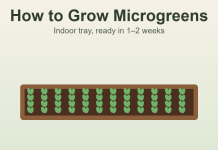
| Microgreens | Easiest | Shallow tray | Fastest harvest and the lowest light needs |
| Baby greens (leaf lettuce, arugula, spinach, endive) | Easy | Tray or pot 2–6 inches deep | Baby leaves in about a month; cut the outer leaves and let the center regrow |
| Herbs such as basil and parsley | Easy | Small to medium pots | Steady pickings on a sunny sill or under lights |
| Compact tomatoes (Red Robin, Yellow Bush Cherry) | Moderate to hard | 1 gallon for micro-dwarfs; 5 gallons or more for larger types | Tiny fruit as early as 45 days after transplanting; needs hand pollination |
| Peppers | Moderate to hard | Medium to large pots | Slow, and they need long hours of strong light |
| Cucumbers | Hard | Large pot with a trellis | Need the most space, light and attention |
Choose varieties bred to stay small. University of Vermont Extension suggests dwarf tomatoes such as Red Robin (6 to 12 inches tall), Yellow Bush Cherry (12 to 24 inches) and Dwarf Arctic Rose (about 36 inches).
Light: the limiting factor indoors
Almost every indoor vegetable problem starts with too little light. A south-facing windowsill can grow greens and herbs if it gets at least 4 to 6 hours of direct sun, but University of Tennessee Extension points out that sunlight is much weaker from fall through spring, which is exactly when most people garden indoors. Grow lights give better and more reliable results.
- Greens: 12 to 14 hours of light a day.
- Tomatoes: 16 to 18 hours a day.
- Distance: keep lights 2 to 4 inches above the tops of the plants and raise them as the plants grow. If the fixture is fixed, stand the pots on books and remove them over time.
- Fixture type: slim LED or fluorescent fixtures suit shelves and windowsills. Tennessee discourages metal halide and high-pressure sodium lamps indoors because they are bulky and hot.
- Use a timer so the schedule never slips.
How bright do the lights need to be? Tennessee gives these targets for plants grown entirely under artificial light for 16 hours a day:
| Crop | Light needed at plant level (16 hours a day) |
|---|---|
| Baby leafy greens and seedlings | About 1,000 foot-candles |
| Bibb lettuce and basil | About 1,400 foot-candles |
| Strawberries | About 2,000 foot-candles |
| Compact tomatoes | About 2,400 foot-candles |
In other words, a tomato needs roughly two and a half times the light of a tray of baby greens. That is why greens succeed under a simple shop light while tomatoes need a stronger fixture. For houseplants rather than food crops, see our guide to grow lights for houseplants.
Containers and potting mix
- Use containers with drainage holes and a drip tray underneath.
- Fill them with sterile potting mix, never garden soil. See how to make your own potting soil.
- Greens need only 2 to 6 inches of depth, depending on whether you pick baby leaves or grow full heads. A clean, recycled food tray with holes poked in the bottom works.
- A micro-dwarf tomato fits a 1-gallon pot; larger varieties need 5 gallons or more.
Temperature and placement
Leafy greens grow best at 60 to 70°F. Tomatoes want 70 to 80°F by day and no lower than 60°F at night. Keep plants away from cold drafts near windows and doors, and from hot, dry air beside radiators, stoves and heating vents.
Watering and feeding
- Water when the top of the mix is dry, not on a fixed schedule. Check with a finger.
- Water until it drains from the bottom, then empty the tray so the pot never stands in water.
- Greens like steady moisture; tomatoes should be watered when the top inch dries out.
- Feed once or twice a month with a soluble or controlled-release fertilizer, following the label. Vermont suggests every two weeks for indoor tomatoes. Compare products in our guide to types of fertilizer.
How to grow a tray of salad greens indoors
- Fill a shallow container with moistened potting mix.
- Scatter seeds about an inch apart, cover lightly with mix and mist with water.
- Cover with a clear dome, plastic wrap or a clear bag to hold moisture.
- When sprouts appear, usually within a week, remove the cover and move the tray under lights for 12 to 14 hours a day.
- Keep the mix moist but not wet.
- Harvest baby greens in about a month, cutting outer leaves when they are 3 to 4 inches tall and leaving the center to regrow.
- Sow a new tray every two weeks for a continuous supply.
The same basic method, with more detail on lights and damping-off, is in our guide to starting seeds indoors.
Growing tomatoes indoors and hand pollination
Indoor tomatoes have no wind or bees to move their pollen. Once flowers open, shake the stem gently, tap the flowers, or brush each one with a cotton swab or small paintbrush. Give the plants 16 to 18 hours of strong light, warmth, and regular feeding. For outdoor growing, pruning and common problems, see our complete guide on how to grow tomatoes.
Common indoor vegetable problems
| Problem | Likely cause | Fix |
|---|---|---|
| Tall, thin, pale seedlings | Not enough light, or lights too far away | Lower lights to 2–4 inches above the plants; lengthen the day |
| Slow growth in winter | Weak window light | Add a grow light on a timer |
| Flowers but no fruit | No pollination | Shake or brush flowers by hand |
| Wilting in wet mix | Pot standing in water | Empty the drip tray; water only when the top is dry |
| Pale or yellowing leaves | Nutrients running low | Feed once or twice a month |
| Clusters of small insects on new growth | Aphids | Rinse off with water and check plants often |
Frequently asked questions
What are the easiest vegetables to grow indoors?
Microgreens, baby salad greens such as leaf lettuce, arugula and spinach, and herbs. They need the least light and are ready fastest.
Can I grow vegetables indoors without grow lights?
Greens and herbs can grow in a south-facing window that gets at least 4 to 6 hours of direct sun, but growth is slow in winter. Fruiting crops such as tomatoes need grow lights.
How many hours of light do indoor vegetables need?
About 12 to 14 hours a day for leafy greens and 16 to 18 hours for tomatoes, with the lights kept 2 to 4 inches above the plants.
Can I grow tomatoes indoors all year?
Yes, if you choose a dwarf variety, give it strong light for 16 to 18 hours a day, keep it warm, and pollinate the flowers by hand.
Sources
- University of Vermont Extension, Growing Edibles Indoors (crops and dwarf tomato varieties, light hours and distance, temperatures, containers, sowing and harvesting greens, hand pollination).
- University of Tennessee Extension, Small-Space Indoor Food Production (W 1288-B) (easiest crops, window light, foot-candle targets, fixture types, watering and fertilizing).